
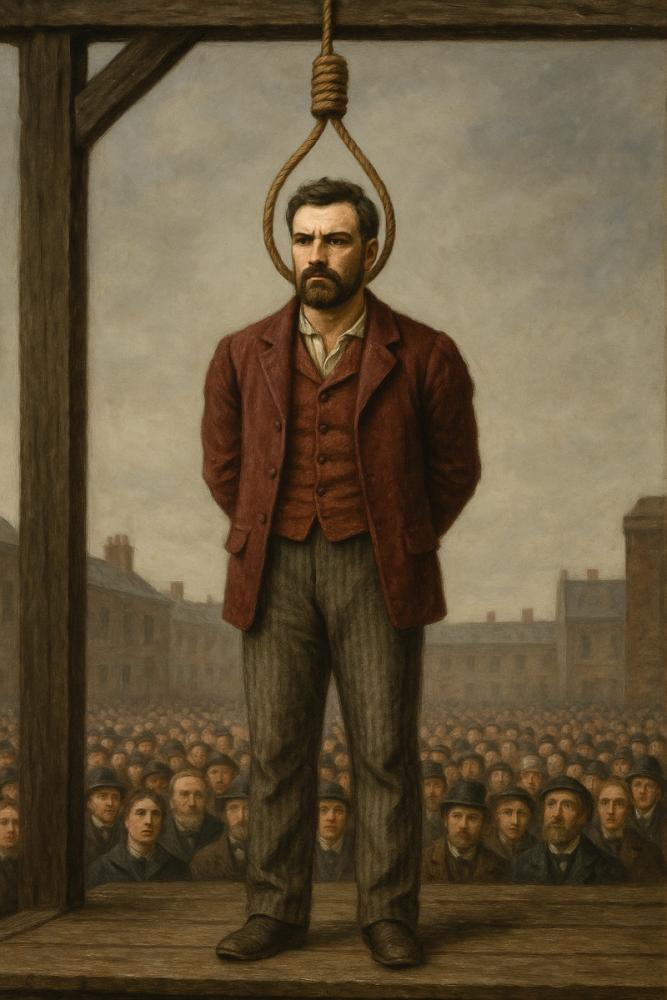
Michael Barrett was a Fenian patriot. Accused of murder he was the last man to be publicly hanged in England in 1868.
When I visited County Fermanagh in May 1994, on asking the locals for information on the Barrett family , I was usually greeted with the comment, “Oh, you must be related to Mickey Barrett.” I had no idea who this Mickey Barrett was, but soon discovered the story of this fascinating ancestor.
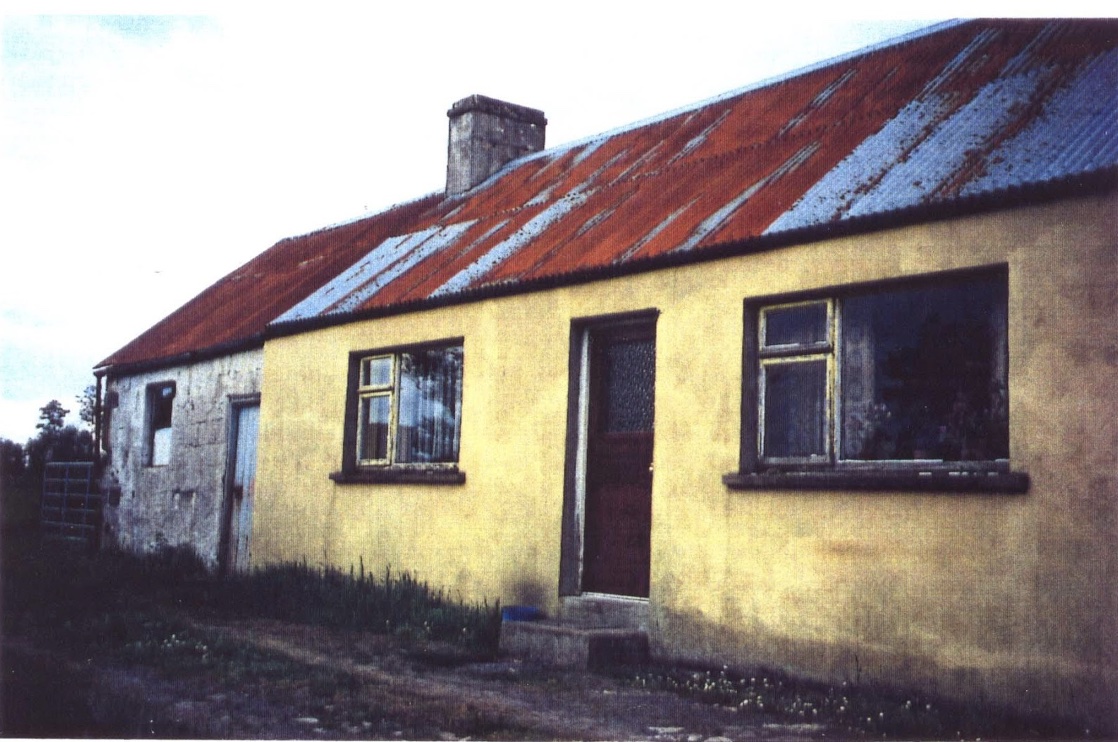
At about the same time as my Barrett family arrived in New South Wales in 1841, Michael Barrett was born to Owen Barrett and his (first) wife Ann, of Drumnagreshiel Townland, in the parish of Drumkeeran just a few miles from my direct ancestors another Owen Barrett, both grandsons of Owen Barrett senior. The 1862 census shows Owen and his son Michael, then 19 years old, still living in this same house with Owen’s second wife Ellen, and Michael’s sisters Ann and Rose.
Screenshot
Michael Barrett’s home in the townland of Drumnagreshiel, Co Fermanagh. (photo by author).
Below is the story of Michael Barrett and his involvement with the Clerkenwell Explosion of 13 December 1867 and his subsequent execution in London. I have taken this information mostly from The Fenians in England 1865-1872 by Patrick Quinlivan and Paul Rose.
In his early twenties, like so many other young Ulster men, Michael left home to live and work in Glasgow. He lived at 65 Crown Street, Glasgow and worked as a weightmaster or stevedore with Connells of Govan Road, Glasgow. He was a friend of Peter McCorry, a writer who later became editor of the Glasgow Free Press. Michael joined the Fenian memovement some time after arriving in Glasgow. This movement, which received much of its support from the USA, traced its origins to the founding of the Irish Republican Brotherhood in Dublin in 1858. The name ‘Fenian’ came from the ‘Fianna’, the legendary band of Irish warriors led by Fionn mac Cumhaill.
The Clerkenwell Explosion
Fenian activity in the 1860s was part of an ongoing movement to secure Ireland’s independence from England. In September 1867 there had been a raid on a prison van in Manchester in an attempt to release Fenian prisoners; a policeman, Sergeant Brett, was shot dead. One Ricard O’Sullivan Burke, a senior planner behind the prison van rescue, was arrested in London on 27 November, and with his assistant Joseph Casey, was formally charged and sent to Clerkenwell Prison.
The Clerkenwell House of Detention was used mainly for prisoners awaiting trial at the Middlesex Sessions House a few yards from the prison. A brick wall, three feet thick at the base and 25 feet high, surrounded the prison and enclosed an exercise yard just over 100 feet long and 60 feet wide. The exercise yard was about three feet below the surface level of the street pavement outside.
The two Fenian prisoners on remand were allowed to buy food and to have visitors. Burke was visited by his sister, Mrs Cathleen Barry, while Casey was visited by Mrs Ann Justice, whose husband was a tailor and a Fenian. Burke wrote often to his lawyer, Dr Edward Kenealy, who passed on some of the letters to Mrs Barry. The letters were of trivial family matters, but on the back of the pages were instructions and notes in invisible ink.
Burke suggested an escape plan, based on surprise and speed. He had noticed a weak point in the prison wall and suggested that an explosive charge be placed in the cutting and fired after a signal had been given to the prisoners. In the confusion after the explosion Burke and Casey were to race to the breach in the wall where friends would be waiting with horses to get them away from the area quickly. The break in the wall was repaired on 10 December only two days before the first rescue attempt.
Following indecision and dissent within the leadership of the Fenian movement, James Murphy, a former Captain of the 20th Massachusetts Infantry Regiment, took over the London branch. In November 1867 Murphy and Michael Barrett travelled to London in high hopes of freeing Burke. Murphy made most of the arrangements for the rescue attempt; gunpowder was purchased and brought to Clerkenwell. A police informant obtained exact details of the plans and Dublin Metropolitan Police were advised of the plot, who passed on their information to Scotland Yard. Security was immediately increased at the prison.
The first rescue attempt was made on Thursday, 12 December. James Murphy and two companions wheeled a barrow through the streets of Clerkenwell. On the barrow rested a 36 gallon beer cask filled with gunpowder and covered by a tarpaulin. Beer casks being no novelty in that part of London the watching police took no notice of the men, not even when they rested the barrow against the prison wall. A white ball was tossed over the prison wall as a signal to Burke who was slowly circling the prison yard with the other prisoners. Burke pretended to have a stone in his shoe and leaned against the wall in a well protected area. He fumbled with his shoe and held his breath, waiting for the explosion and a desperate race to the wall in the confusion.
Outside the wall Murphy lit the fuse and hurriedly retreated to a safe point. The fuse spluttered and went out. Murphy returned to the barrel, relit the fuse and hurried back to his companions. For the second time the fuse went out. Once more Murphy lit the fuse, now dangerously close to the barrow, and again the fuse went out. After a hasty consultation with his small group Murphy gave the order to wheel the barrow away. In the exercise yard a warder ordered Burke back into line. He delayed as long as possible but finally had to rejoin the circle and return to his cell. The attempt had failed.
The Fenians held a meeting and decided to try again the following day at the same time. On Friday afternoon Ann Justice visited the prison to make known the change of plan. Burke was then unaware that the Governor had decided to cancel the normal exercise period for that day, and had put on extra guards as precaution against a surprise attack on the prison. Soon after 3.30 James Murphy, Michael Barrett and Jeremiah O’Sullivan wheeled the barrow to the prison wall. The fuse was lit and the group hastily retreated to shelter after making sure that the fuse was well alight. But by this time both Burke and Casey were in cells on the opposite side of the prison.
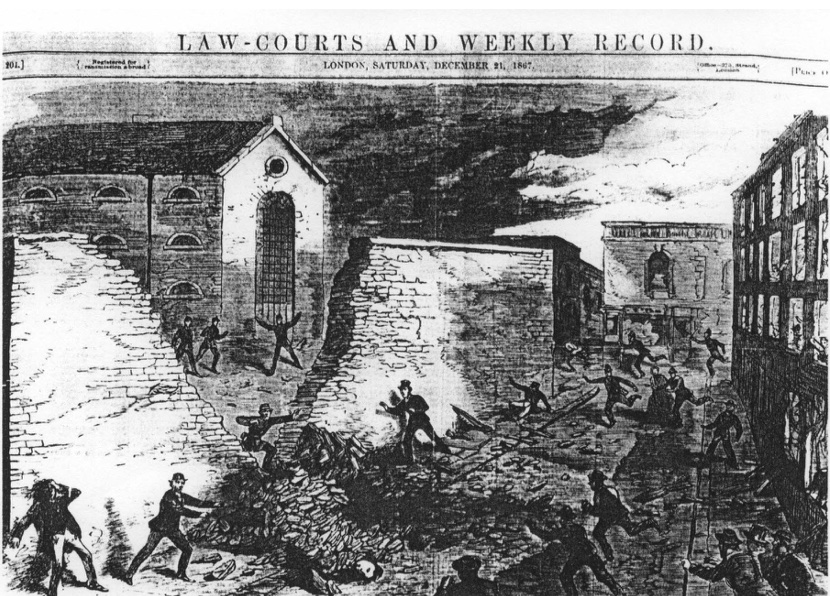
The barrel exploded. James Joyce in Ulysses writes of a “flame of vengeance hurling the walls of Clerkenwell upward in the fog”. There was no fog but smoke and dust filled the scene blotting out all details. A hole was blown in the wall but most of the blast effect went across the road. Slum dwellings in Corporation Lane collapsed and fires broke out. Shattered glass and rubble filled the street. Women and children screamed and thousands of excited and terrified Londoners poured into the streets. The hole in the prison wall was twenty feet wide at the base and sixty feet wide at the top. Barrett and O’Sullivan raced to the prison wall and peered in. They saw that the exercise ground was empty and that armed warders were already taking up guard positions.
Three people were immediately arrested. Jeremiah Allen, who had been loitering outside the prison and refused to leave, was seized, beaten and accused of causing the explosion. It eventuated that Allen was acting as a police spy and had hoped to claim a reward for information. Timothy Desmond, a 46 year old tailor, was arrested and Ann Justice who had been seen running away. PC Sutton had been watching her for some time because of her frequent visits to the prison.
Eye-witness accounts of the man who lit the fuse varied considerably. The policeman Ambrose Sutton, said he saw a man with red hair and an American style goatee beard run away after firing the barrel. This description fits Jeremiah O’Sullivan who claimed in later years that he fired the fuse and eluded the police. O’Sullivan reached America safely and died there in 1922 at the age of seventy-seven. He recounted the tale to his family many times over the years, blaming Burke for the loss of innocent life in the explosion and said it was due to the excessive amount of gunpowder used.When the damaged houses had been searched and cleared it was found that three persons had been killed and over one hundred injured. The next day a fourth woman died of injuries and later a further two were buried in the same grave in Finchley Cemetery. An inquest on the four dead was held and the jury recorded a verdict of wilful murder against Jeremiah Allen, Timothy Desmond and Ann Justice. Soon after Jeremiah Allen was released, having at last been able to convince the police that he was indeed working on their behalf.
Screenshot
The explosion caused a flood of rumours all over the country; no story was too fantastic to be disbelieved and the fear of further Fenian action produced a situation amounting to panic in many quarters. All leave was cancelled as the Army and Police stood by to face the expected Fenian attacks. A nation wide call was made for volunteers to act as special constables in the emergency and no less than 166,000 were enrolled.
The scare was strongly aided by newspaper accounts of Fenian raids. The Times called the Clerkenwell Explosion ‘one of the most heinous, most reckless, and most foolish outrages that are to be found in the records of crime.’ The Observer referred to the explosion as an ‘atrocious Fenian outrage’. Queen Victoria sent a message of sympathy and some hothouse grapes to the sufferers and regretted she was unable to visit them. The Prince of Wales visited the scene twice and went to the hospitals to see the wounded.
The Clerkenwell Trials
Among the men arrested in London soon after the explosion was Patrick Mullany, a tailor from Dublin. Sixty-two persons were to be called to give evidence against Mullany; he was inplicated in the Manchester and Clerkenwell events and faced a death sentence. He was offered various inducements to give information. He denied taking part in the rescue attempt but added ‘I am partly sure, that Captain Murphy and Jackson, both from Glasgow, are the two persons who planned the explosion at Clerkenwell … … Jackson told me he fired the explosion’. The police asked him if Jackson was also known as Barrett and Mullany cautiously agreed ‘it might be so’. Obviously the police had some information about Michael Barrett from another source. Police throughout the British Isles were asked to look for Barrett and an accurate description of him was circulated.
Three days after Mullany had made his statement the Chief Constable of Glasgow reported to the Magistrates that two men had been found firing pistols in Glasgow Green at midnight. The men were James O’Neill and Michael Barrett. They were taken to the police station, searched and then released. On 13 January 1868, a month after the explosion, the police came to Michael’s lodging at 32 Centre Street, Glasgow and arrested him claiming they had found a revolver. The Glasgow police notified the Home Office of the arrests and the two men were brought to London and charged with complicity in the Clerkenwell explosion. James O’Neill faded out of the case quickly. Mullany made statement after statement, each one longer than the last. Eventually on 22 January he asked to see senior officials and told them ‘Yes, I’ll turn informer’.
Soon after his arrest and arrival in London, Michael Barrett wrote to his friend Charles McManus in Glasgow:
Millbank Prison, London, 24 January 1868
My Dear Friend,
You will I have no doubt be very much grieved upon hearing of the series of reverses that have befallen me lately, the cause of which I am as ignorant of as yourself; nevertheless, I have got into the meshes of the law, and when once fairly entangled, it is no easy matter to get extricated, of course it is needless for me to enter into details as no doubt you have learned all the particulars through the public press before this, however I wish you to go to Mr James Mullen and he will bring you to the shoemaker named McNulty in Bridgegate Street. I do not know the number. Mention my name to him and see if he remembers doing a little work for me at the time this crime of which I am charged with being the author was committed; if he does not recollect the name, mention the few following incidents that took place, namely, that I was the party who waited upon him on three different occasions to have my boots bottomed, first on the Thursday, then again on the Friday night when he promised them certainly on Saturday, and upon me going for them on Saturday I kicked up a row on account of him not having done anything to them and that he had to get two men who were in the place to assist him to do them as I could not leave without them and during the time they were working I sent out for The Evening Post and read for them an account of the Clerkenwell Explosion which was the first thing they heard of it. Now I think this should bring the matter quite clearly to their remembrance. You will also tell McNulty that if these two men have left him he must find them and also who the other parties are who were in the place at the time. I wish you to go to my lodgings at once, and take anything of mine that there is out of it, and if you can, send me a change of underclothing. There is nothing I need more at present. You should see Mr Lewis about them. Mr O’Neill wrote on Tuesday but I do not know who to or whether he got an answer as we do not get speaking. I will write again on Wednesday.
I am, sir, as ever, yours.
MICHAEL BARRETT
P.S. You will please send me the red Crimea shirt that you will find in my lodgings and drawers are what I need most. You will also find some collars of which I would like you to send me a few. You may rest assured we are in a miserable enough condition here being without friends or acquaintances to do anything for us. Now please not to neglect what I have told you to do, write at once. All letters are read by the Governor. I would also wish you to send me a pair of stockings. See Mr Lewis at once. Mr Mullen will bring you to him he will also bring you to my old lodgings. I hope you at least do not accuse me of being guilty of this charge. Please write by return.
Six people were arrested for the crime, and on 20 April 1868 crowded into the dock of the Old Court at the Old Bailey stood Michael Barrett, Ann Justice, John O’Keefe, Timothy Desmond, William Desmond and Nicholas English. In 1868 there were no funds to pay for legal defences for poor prisoners and appeals in Irish papers had produced just enough to pay young lawyers at the beginning of their careers. For Baker Greene, who defended Michael Barrett, it was his first appearance in a murder trial and he had just ten days to prepare the defence. The case was to heard by two judges and the charge was murder.
Reporters noted the poor state of the prisoners, their faces pallid from the long confinement. Only Barrett stood out; he had not been in gaol as long as the others and his clothes were in better condition. Barrett looked round with interest but the other men seemed cowed by the court. Charges were eventually dropped against Ann Justice and John O’Keefe. Eventually, Michael Barrett, William Desmond, Timothy Desmond and Nicholas English would stand trial. The charge was murder, the murder of Sarah Anne Hodginson, who had been killed by flying glass when the gunpowder exploded. The cases against William and Timothy Desmond and Nicholas English collapsed due to lack of substantial evidence. The evidence against Michael Barrett was not strong; he had been identified very uncertainly by witnesses whose evidence was contradictory. The chief witness against him was Mullany, who had named him even before his arrest. But Mullany had declared that Michael Barrett and James Murphy had come specially from Glasgow to rescue Ricard Burke, thus flatly contradicting the witnesses who claimed they had known Barrett in London for some weeks before the explosion. But Barrett’s defence did not rest on insufficient evidence or misidentification, there was the letter from Barrett to his friend Charles McManus. If the details in the letter were correct Barrett was in Glasgow at the time of the explosion. Only Barrett offered an alibi and produced witnesses to support it.
Barrett’s alibi was supported by Peter McCorry, editor of the Glasgow Free Press newspaper, and by a number of members of the Glasgow Irish community. They swore that Michael Barrett had been with them at a meeting on 12 December to commemmorate the Manchester executions. A statement that Barrett was in Glasgow on 12, 13 and 14 December was made by the shoemaker Michael McNulty and supported by two other shoemakers, John Peak and John Walsh. Then came Charles McManus. He took the Bible in his hand, repeated the oath, then raised the book reverently above his head at arm’s length before kissing it. He swore that Michael Barrett was with him in Glasgow on Friday, 13 December.
The Attorney-General summed up by attacking Barrett’s alibi. He stressed that the evidence of two witnesses showed that Barrett had been in London for some weeks before 13 December. Lord Chief Justice Cockburn dealt briefly with the evidence against the Desmond brothers and Nicholas English and went on to say that the alibi of Michael Barrett was one of the most remarkable he had ever known. The jury would have to decide on the credibility of the witnesses for the prosecution; on the other hand the defence alibi was so remarkable and peculiar that it required vigilant attention before it could be adopted. If Barrett had declared immediately on arrest that he was in Glasgow on and before 13 December the police would have searched for witnesses for him. But Barrett had not said one word to that effect when he was arrested and the Judge thought this was unnatural. … … He felt that evidence of those who had lodged with Barrett was needed. Barrett must have had a home of some sort. Someone must have known where he slept, employers or fellow workmen could surely have come forward to speak for him.
On 27 April 1868 the jury retired to consider the verdict. The dingy, overcrowded court buzzed with conversation; the corridors of the building were blocked with people, while outside an immense crowd gathered to hear the trial result. After two and a half hours, the jury brought in a verdict of not guilty to all those arrested, except Barrett who was found guilty. The three acquitted prisoners were removed from the dock leaving Michael Barrett alone. Barrett was allowed to speak and without notes he made a speech which brought tears to many eyes and made a deep impression even on those hostile in every way to Irish republicanism..
Michael Barrett’s Speech from the Dock
“I have a great deal to say. Nevertheless, I do not intend to occupy much of your Lordship’s time, being fully conscious that any words of mine would in no way alter your Lordship’s mind in this matter. Still, I cannot allow this opportunity to pass, as it is likely to be the only one I shall have on this side of the grave, of endeavouring to place myself as I should like to stand before my fellow men. In doing so I may be compelled to expose the means that have been resorted to for the purpose of securing my conviction. I am not, however, going to adopt a whining tone or to ask for mercy; but yet I address your Lordship as a humble individual whose career has been mercilessly assailed and I wish to defend it, conscious as I am that I have never wilfully, maliciously or intentionally injured a human being that I am aware of … no, not even in character.
“True, I stand charged with one of the most repulsive of crimes … that of murder, yet when I come to examine the terribly conflicting character of the evidence I find there are not two of the witnesses who do not directly contradict each other. Those who profess to have been eye witnesses of the deed all agree that the man who fired the barrel was of gentlemanly appearance … a tall man, five foot ten or more in height. Considering the impossibility of mistaking such a person for a man of my humble apperance and who is only five foot six. After taking all these things into consideration, and after the incontestable testimony that I was not in London at that time, I express my firm conviction that there is not an unprejudiced man … if it were possible for such a one to find his way into this place, that will not be convinced of my innocence. No, it is my most conscientious conviction that the jury cannot in their hearts believe me to be a murderer.
“I would not endeavour, with your permission, and as far as my humble abilities will allow me, to review a little of the evidence that has been brought against me. But, it would be presumptious, and almost impertinent, in me to deal with the matter after the manner in which my talented Counsel has analysed that evidence. In consequence, however, of some remarks of the Attorney-General and your Lordship I am compelled to advert to that evidence.
“I will first speak of my arrest in Glasgow and the way in which I was subsequently smuggled to London. I was taken to the police court there and searched, and yet nothing was found which they could twist into a charge against me. I was set at liberty, and before I was liberated I gave them my name and address, which no man would have done in such a position if he was apprehensive of being taken on a charge of murder. They afterwards came to my lodgings and re-arrested me, urging as their reason the finding of a pistol, and I must confess my regret that the witness was not called by the Crown, for in that case I should have proved that the pistol which he alleged I fired three shots from on a Glasgow Green was perfectly useless. This I heard from a person who was present at the police court. No one could use that pistol. I was brought up two days for examination without once being permitted to open my mouth, and I was ordered off to gaol for nine or ten days with a view of allowing time for further enquiries into the case. They found everything I told them was correct, but they also found what suited their purpose exactly, namely, that I was just recovering from a lengthened illness, and had exhausted my means, and once they got me out of Scotland I was completely in their power. I was hurried off to London, where they knew I was alone and in their power. Their nervous haste, indeed, has subjected me to the most flagrant injustice.
“I do not allude to the high authorities in Glasgow, but I do to the mean, petty, truckling creatures who hang about police courts, and who would not hesitate to have recourse to the most vile and heinous practices to benefit themselves, or even to gain a smile of approval from their superiors. They will now congratulate themselves on the success of their schemes. I will next speak of that box Wheeler. When I was first confronted with him in London, after a careful and lengthened examination, and after going to a considerable distance, he was seized by a police-officer, or rather a wretch bearing the uniform of one, and brought back in front of me and held there by the shoulder until he was compelled to admit that he knew me. I cannot find words to express my utter contempt and detestation for a wretch who could so intimidate a child for the purpose of swearing away a fellow-creature’s life. The boy’s timidity in the witness box must have been apparent to all who saw him. However repulsive the act may have been, it may have been in harmony with the principles of a man who has been familiar with the dens of London thieves, and with the treachery, trickery and deceit so often found in the official costume of Scotland Yard.
“I would now speak of the man Bird … or rather that miserable Bird. He first identified O’Neill, and here comes in the treatment of officials. After he had done so and gone away he returned and I was called out, and in the hearing of Bird asked my name and where I was born; in the presence of the Chief Warder. Upon that Inspector Thompson at once took up his cue, and, coming back to the cell, said he preferred me. No doubt he did, and was desperate at the idea of losing his portion of the bribe. I will now turn to the highly respectable witnesses from Pulteney Court. As to the evidence of the woman Kemsley, I think it is rather too inconsistent to bear part in depriving a human being of life. She swore she saw me for two months at that woman’s house, and on several particular occasions, on one of which she said I was going to take a walk of pleasure with the woman of the house on a Sunday evening, and was carrying carpet bag. It is, I think, a very inconsistent and improbable story that I should be carrying a carpet bag at such a time. Here standing and looking into the grave I most solemnly declare that at the time those people swore I was at that place I was in Scotland; and the statements of the others are equally false.
Judge: Is there anything else you wish to say?
“I would next speak of the boy Morris. His contradictions were so apparent as to the time at which he said he saw me that I think no-one would admit that his evidence had any importance and I may pass it by. I will now come to that prince of perverts, Mullany, and his satellites. I will first speak of the boy Morris. He swore on the evening of the explosion that I came to his master’s place with my face and neck black with gunpowder. Well, I think, even such a ridiculous assumption requires no comment, and nobody but a puny-minded tailor’s boy would be guilty of such a fabrication. He was brought here to corroborate his master, Mr Mullany, and see how far he does it. He swears I spent ten minutes in Mullany’s house that evening. Mullany swears he never saw me there. This is what Her Majesty’s Attorney-General calls corroborative evidence.
“Let us see how far the woman Koppel corroborates Mullany. Mullany says I had a full beard all around my face. The woman says I had not. The Attorney-General calls that corroborative evidence. Let us see how Koppel and Morris corroborate each other. The boy swore Mullany sat on his board on the evening of the explosion until eight o’clock and the woman swore that soon after six o’clock she met him in the street drunk. This is what the Attorney-General calls corroborative evidence, and if you, gentlemen of the jury, believe him, you will get few to believe you or the Attorney-General.
“If one fact more than another could be urged to show the utter groundlessness of these people’s statements, it is that Mrs Mullany has been unable to identify me as the man Jackson; and if she could have done so the Crown would most willingly have brought her here as a witness against me.
“While dealing with these facts I will just mention one single incident, for which the Attorney-General for his ingenuity was unable to account. We are told by the informer Mullany that I and Captain Murphy came from Scotland with the avowed intention, and no other, of rescuing Burke from Prison. Morris and Koppel, on the other hand, swore that I had been in the habit of visiting Mullany’s six weeks before the explosion. On returning to the depositions, I find the warder of the House of Detention states on oath that Burke was only three weeks in prison at the time of the explosion. This is what the evidence of the witnesses is worth when you come to test it by independent facts, and that is what the Attorney-General calls corroborative evidence to send a human being to the scaffold.
“Now referring to that fiend of iniquity, Mullany, I will pass him over with as few words as possible, as though by the very mention of his name I should inhale a most deadly poison. Him I shall allow to remain in his wretchedness and misery. In the words of Holy Writ, “When your fear cometh as a desolation and your destruction cometh as a whirlwind; when distress and anguish cometh upon you, trouble and anguish will make him afraid; they shall prevail against him, as a King ready to the battle. Men shall clasp their hands at him and shall hiss him out of his place.” His, indeed, is a life that no one will envy, and everyone, even the most abandoned, will despise him. The very parties who now smile upon and have recourse to him will spurn him. A thousand times more welcome is death to a criminal convicted of the highest crime than life and so-called liberty at the sacrifice of everything that tends to elevate the human being and renders him worthy of the name of man.
“With reference to the explosion, I will say just a few words. It is useless for me to enter into protestations of innocence, being fully aware that no declarations of mine will have the slightest tendency to prevent your Lordship from following the course you have determined to pursue. But this I can and will most solemnly declare; there is no one who more deeply commiserates with the sufferers from that explosion and no one who more earnestly deplores the fatal consequences than I do. No, I am not one to rejoice over misery, or find pleasure in the suffering of my fellow creatures, the statement of Mullany to the contrary notwithstanding. Him, even him, I can forgive, and pray that his sufferings may not be so great as he deserves.
“I would wish to correct a statement that has been made here that I was the author of the explosion. There never was a greater mistake than to give me credit for such an undertaking as that explosion. It was utterly absurd to suppose so, being as I am, a total stranger to acts of daring and without any experience which would in any way fit me for engaging in such an enterprise, and if it be attributed to the Fenian organisation, then it becomes ridiculously absurd. According to Sir Richard Mayne and the Pall Mall Gazette, there are ten thousand armed Fenians in London, and that they should have to send to Glasgow to do this work, and there to select a person of no higher condition and no greater abilities than the humble person who now addresses your Lordship is a stretch of imagination which the disordered minds of the affrighted officials could alone be capable of entertaining. It was said why did I not bring up my master and my lodging house-keeper. I gave the police at Glasgow my late master’s name, with whom I had been working for months. The police went and found the place but they carefully avoided to publish.
“I could have established my innocence. It was urged why did I not bring them to the police court. My solicitor applied for the means to bring them from Glasgow and he was denied. How to account for the conduct of the Governor of Millbank I am at a loss to know. He suppressed a letter I had written to a friend and sent it to that respectable gentleman, that notorious detective McCaul of Glasgow who, with the true ingenuity of a detective, went to McNulty, and so misrepresented the facts to him as to throw him off his guard.
“I am far from denying, nor will the force of circumstances, compel me to deny my love of my native land. I love my country, and if it is murderous to love Ireland dearer than I love my life, then it is true I am a murderer. If my life were ten times dearer than it is, and if I could by any means redress the wrongs of that persecuted land by the sacrifice of my life I would willingly and gladly do so. As your Lordship has said, I will now turn my attention to that other land where the injustice of selfish mortals cannot follow me, where man has no longer the power to persecute his fellowmen, and where might no longer triumphs over right.”
When Barrett was finished Cockburn passed sentence of death adding that there was no hope of reprieve and that Barrett should prepare himself for death. The judge’s summing up and comments became a classic example for English law for nearly a century and were quoted in many murder trials until the passing of the Homicide Act of 1957. The rules applied to Irish prisoners in British courts did not admit political motives but allowed the charge of treason or treason-felony. In brief, an act committed for political purposes but known to be dangerous would be treated as premeditated murder if any life was lost. If two or more persons took part in such an act leading to a death all the persons involved were liable to a death sentence and not only the person who did the actual killing, intentionally or unintentionally.
Cockburn accepted that the Fenians did not aim to kill anyone but he pointed out that the death of Sarah Hodgkinson could have been foreseen. A foreseen outcome was enough for the law, even if the possible outcome was not wanted. There was logically room for the Fenians to hope that no one would be killed by the explosion but they had the indirect knowledge of the possible consequences. Following sentencing, Michael Barrett was taken from the dock to the comdemned cell at Newgate Prison.
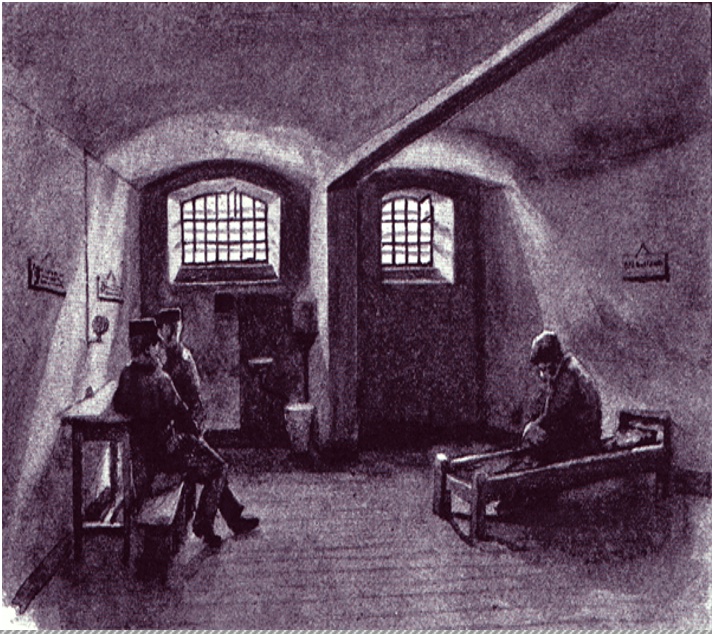 Screenshot |
| Source: Luker Jr W. Newgate — The Condemned Cell in Loftie WJ. London City — Its History, Streets, Traffice, Buildings, People, 1891. |
There were growing protests about the death sentence pronounced on Michael Barrett. John Mallon, Superintendent of the Dublin Police, felt that the death sentence on Barrett was a political execution and did not believe he caused the explosion. There were many requests for a reprieve or a retrial but the general feeling in Parliament was strongly anti-Irish and the consensus of opinion was that even if Barrett was not guilty of causing the Clerkenwell Explosion, he was a self-confessed nationalist, a Catholic and a Fenian and should therefore be executed.
There were two postponements while arguments were thrashed out and there was strong feelings both for and against the execution; Barrett himself seems to have had little hope of a reprieve. The British press noted that no member of his family called to see him. In Fermanagh his mother, a widow with two young children, had walked six miles through heavy snow to Lisnarick, near Irvinestown to beg the local MP, Captain ME Archdale, to help gain a reprieve. Her plea was rejected and she was told that her son and all other Fenians should be hanged, the sooner the better. There was strong pressure on the Government to carry out the execution. Queen Victoria, in a letter to the Home Secretary, said she was grieved “to see the failure of the evidence against all but one of the Clerkenwell criminals … it seems dreadful for these people to escape … one begins to wish that these Fenians should be lynch-lawed and on the spot. What is to be done about Barrett”?
Barrett wrote from his cell to a Glasgow newspaper, in effect thanking those who had spoken out on his behalf “knowing me to be innocent of the crime for which I am called upon to suffer”. And he went on:
“What a strange and striking contrast to the paid witnesses of the Crown, with the gold of Government jingling in their pockets, and their gilded bribe dangling before their eyes, ready to be grasped the moment they had secured my conviction.
“I am wholly at a loss to know by what means the jury came to the decision they did, the only evidence upon which the Attorney-General dared ask them for a verdict being that of the terrible man Mullany and the two people who were in the habit, they said, of seeing me at his place; yet in every other particular they not only contradicted Mullany, but they contradicted each other also.”
On 25 May, Michael Barrett was told the Home Secretary had rejected all pleas for mercy and that the execution would take place the following day. The warders commented that Barrett was calm and dignified during his four weeks in the condemned cell. And he spent much of the time with Father Hussey, a Catholic priest from Moorfields Church. The warders also noted that Barrett never claimed to be in Glasgow on 13 December but only that he was convicted on insufficient evidence and that he had never committed murder.
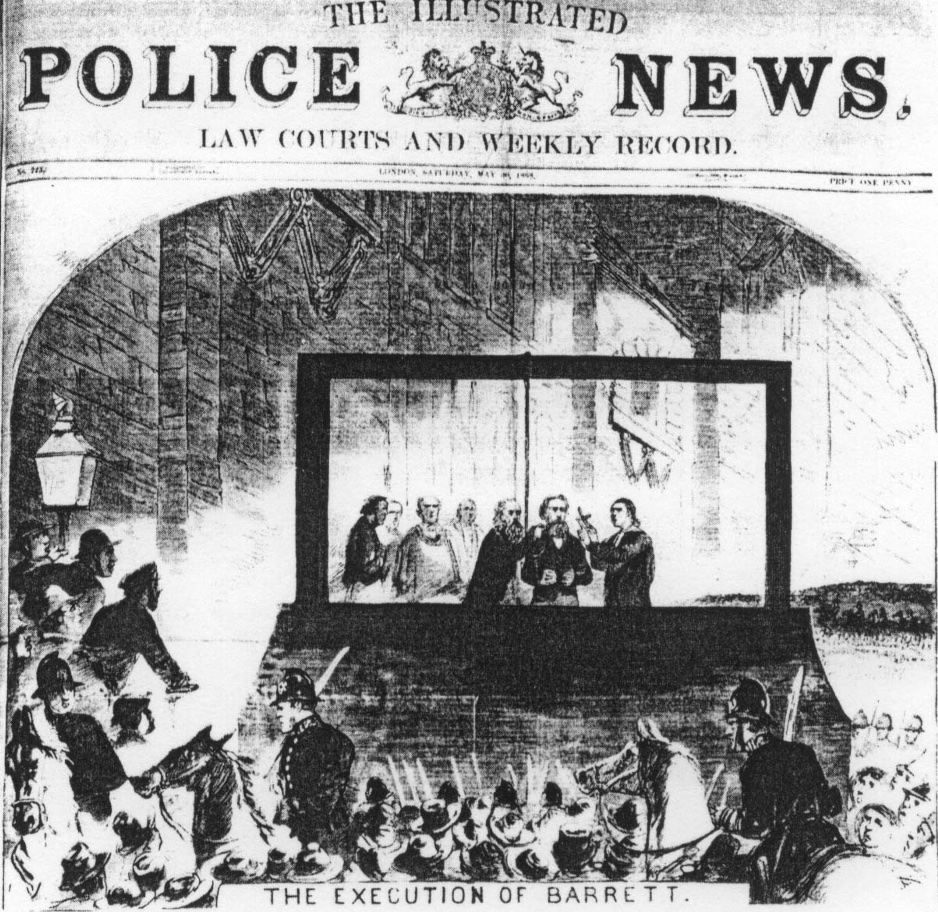
It was well known that the execution was to be the last public execution in England and by 11 pm nearly 2000 people had gathered. Prices for a room with a view of the execution went as high as £10. William Calcraft, public executioner for England for forty years, arrived to do his grim work for a fee of twenty guineas. He was an old man, fond of brandy, with a reputation for being a chronic bungler. It was his practice to climb on the back of his victim to kill him if the length of rope had been miscalculated.
Barrett was called at 6.30am and received communion from Father Hussey at 7 am. His face was pale as he walked the long corridor. Observers reported his demeanour as being remarkably firm without a trace of bravado. He was dressed in the same suit of Donegal tweed he had worn at the time of his arrest and trial. Barrett walked up the steps to the scaffold. As he came into view there was a cheer from the crowd, plus a few boos and hisses. Barrett ignored the scene and seemed attentive only to the voice of the priest beside him. Near the foot of the scaffold stood William Desmond and by his side was a heavily veiled young woman; she was crying. Calcraft quickly placed a hood over Barrett’s head and put the noose round his neck. Barrett spoke to Calcraft through the hood and asked for the rope to be adjusted.
The bolt was drawn and the drop fell with a loud boom. Michael Barrett’s body plunged down and he died without a struggle.~
Screenshot
The Times of Wednesday, May 27, 1868 reports The Execution of Barrett, viz:
“Yesterday morning in the presence of a vast concourse of spectators, Michael Barrett, the author of the Clerkenwell Explosion, was hanged in front of Newgate. In its circumstances there was very little to distinguish this from ordinary executions. The crowd was greater, perhaps, and better behaved; still, from the peculiar atrocity of the crime for which Barrett suffered, and from the fact of its being probably the last public execution in England, it deserves more than usual notice.
“On Monday the barriers were put up, and on Monday night a fringe of eager sightseers assembled, mostly sitting beneath the beams, but ready on a moment’s notice to rise and cling to the front places they had so long waited for. There were the usual cat-calls, comic choruses, dances, and even mock hymns, till towards 2 o’clock, when the gaiety inspired by alcohol faded away as the publichouses closed, and popular excitement was not revived till the blackened deal frame which forms the base of the scaffold was drawn out in the dawn, and placed in front of the door from which Barrett was to issue. Its arrival was accompanied with a great cheer, which at once woke up those who had been huddled in doorsteps and under barricades, and who joined in the general acclamation. The arrival of the scaffold did much to increase the interest, and through the dawn people began to flock in, the greater portion of the newcomers being young women and little children. Never were these more numerous that on this occasion, and blue velvet hats and huge white feathers lined the great beams which kept the mass from crushing each other in their eagerness to see a man put to death.
“The crowd was most unusually orderly, but it was not a crowd in which one would like to trust. Some laughed, some fought, some preached, some gave tracts, and some sang hymns; but what may be called the general good-humoured disorder of the crowd remained the same, and there was laughter at the preacher or silence when an open robbery was going on. None could look on the scene, with all its exceptional quietness, without a thankful feeling that this was to be the last public execution in England. Towards 7 o’clock the mass of people was immense. A very wide open space was kept round the gallows by the police, but beyond this the concourse was dense, stretching up beyond St Sepulchre’s Church, and far back almost, into Smithfield – a great surging mass of people which, in spite of the barriers, kept swaying to and fro like waving corn.
“Now and then there was great laughter as a girl fainted, and was passed out hand over hand above the heads of the mob, and then there came a scuffle and a fight, and then a hymn, and then a sermon, and then comic song, and so on from hour to hour, the crowd thickening as the day brightened, and the sun shone out with such a glare as to extinguish the very feeble light which showed itself faintly through the glass roof above where the culprit lay.
“The convict Barrett had retired to rest about 10 on the previous evening, and, having spent a somewhat restless night, rose at 6 yesterday morning, dressed himself, and engaged in prayer. Shortly afterwards he was joined in his cell by the Rev James Hussey, attached to the Roman Catholic chapel in Moorfields, who had attended him regularly since his conviction, and who remained with him to the last. It is understood that he received the sacrament one day last week, and again yesterday morning.
“Towards 8 o’clock the Sheriffs paid him a visit, accompanied by the Governor, and then retired to a part of the prison leading to the Scaffold, where the rest of the authorities and the public representatives had already assembled. By a pre-determined arrangement, and contrary to the usual practice, the convict was not pinioned in the press-room, as it is called, but in his own cell, and, this process over, he was conducted to the drop by a private way, accompanied by his priest and attended by the executioner and three or four warders, the prison bell and that of St Sepulchre’s Church, hard by, tolling the while.
“The Sheriffs and Under-Sheriffs, who, with others, stood in a group in a gloomy corridor behind the scaffold, just caught a glimpse of the doomed man as he emerged with his attendants from a dark and narrow passage, and turned a corner leading to the gallows. He was dressed in the short claret-coloured coat and the gray striped trousers, both well worn, by when he had become familiar to all who were present during his protracted trial. His face had lost the florid hue it then wore, and in other respects he was an altered man.
“With the first sound of the bells came a great hungry roar from the crowd outside, and a loud, continued shout of “hats off,” till the whole dense, bareheaded mass stood white and ghastly-looking in the morning sun, and the pressure on the barriers increased so that the girls and women in the front ranks began to scream and struggle to get free. Amid such a scene as this, and before such a dense crown of white faces, Barrett was executed. His clergyman came first. Barrett mounted the steps with the most perfect firmness. This may seem a stereotyped phrase, but it really means more than is generally imagined. To ascend a ladder with one’s arms and hands closely pinioned would be at all times difficult, but to climb a ladder to go to certain death might try the nerves of the boldest. Barrett walked up coolly and boldly. His face was as white as marble, but still he bore himself with firmness, and his demeanour was as far removed from bravado as from fear.
“We would not dwell on these details, but from the singular reception he met as he came out upon the scaffold. There was a partial burst of cheers, which was instantly accompanied by loud hisses, and so it remained for some seconds, till as the last moment approached the roars dwindles down to a dead silence. To neither cheers nor hisses did the culprit make the slightest recognition. He seemed only attentive to what the priest was saying to him, and to be engaged in fervent prayer. The hangman instantly put the cap over his face and the rope round his neck. Then Barrett turning spoke through his cap and asked for the rope to be altered, which the hangman did.
“In another moment Barrett was a dead man. After the bolt was drawn and the drop fell with the loud boom which always echoes from it, Barrett never moved. He died without a struggle. It is worthy of remark that a great cry rose from the crowd as the culprit fell – a cry which was neither an exclamation nor a scream, but it partook in its sound of both. With the fall of the drop the crowd began to disperse, but an immense mass waited till the time for cutting down came, and when 9 o’clock struck there were loud calls of ‘Come on, body snatcher!’ ‘Take away the man you’ve killed!’ etc. The hangman appeared and cut down the body amid such a storm of yells and execrations as has seldom been heard even from such a crowd.
“The body on being taken down was placed in a shell and removed to an adjoining building. There the rope having been removed from the neck, and the leathern straps by which the legs and arms had been pinioned, the surgeon certified that life was extinct. The expression of the face was marvellously serene and placid, and the features composed to a degree irreconcilable at first sight with the notion of a violent death, though the lips and parts of the forehead were unusually livid.
“What he may have said to his priest, if anything, in reference to the murders may never be divulged. All that is known is that he gave him “immense satisfaction,” to use that gentleman’s own expression, by his humble and penitent demeanour, his extraordinary fortitude, and by the earnestness with which he strove to prepare himself for his end.”
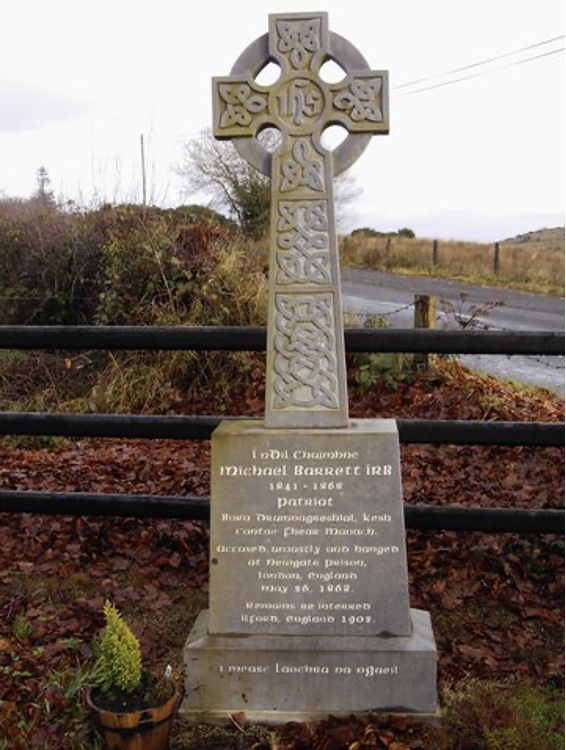
That evening a death mask of Michael Barrett was made for the prison museum, the face calm and composed with no sign of violent death. There are several unidentified death masks in the Crime Museum at New Scotland Yard. I have been in touch with Alan Moss of the Friends of the Metropolitan Police Historical Collection and have sent him whatever descriptions I have of Michael and the newspaper artists’ drawings as well. Maybe one day some further information will come to light which will help us to identify which mask might belong to Michael Barrett. In 1902, when Newgate gaol was demolished, the remains of all prisoners buried within the prison walls were taken in fifty boxes to the City of London cemetery in Manor Park, Ilford. They are in plot 340. Michael’s remains are in one of six graves numbered from 42928 to 42933.
On May 27th, following the execution, Reynold’s News commented:
“Millions will continue to doubt that a guilty man has been hanged at all; and the future historian of the Fenian panic may declare that Michael Barrett was sacrificed to the exigencies of the police, and the vindication of the good Tory principle, that there is nothing like blood. For a time afterwards the term “Mick Barretts” was used as a perjorative for nationalists; this was shortened to “Micks” and was the origin of the term bestowed on all Irishmen, and oddly enough on members of the Irish Guards Regiment serving in the British Army.
Michael Barrett’s grim prophecy about the future of Patrick Mullany came true. Mullany got £100 from the British Government and free travel to Australia. He led a short and miserable life there and died a violent death.
Michael Barrett’s name is included on the National Monuments in Cork and Dublin and an annual memorial service was held in Cork until recent years. The first Republican Club in Irvinestown, Co Fermanagh was known as the Michael Barrett Club and the Sinn Fein Club in Irvinestown was also named after Michael Barrett. In 1968 an exhibition to mark the centenary of the last public execution was held in the London Museum, which attracted a large attendance.
A description of Michael Barrett – extract from Quinlivan’s book:
“He was an Ulsterman, born in Drumnagreshial in the parish of Drumkeeran, County Fermanagh. At the time of the trial he was twenty-six years old. He made a good impression on all who met him. The Times reporter noted his bright resolute eyes, short crisp beard, thick hair, muscular body, and his look of determination and frank courage. One of the trial lawyers, Montague Williams. described Barrett as a ‘square-built fellow, scarcely five foot eight in height, and dressed something like a well-to-do farmer’. He also noted a frank, open expression and added ‘a less murderous countenance than Barrett’s indeed, I do not remember to have seen. Good humour was latent in every feature’. The Daily Telegraph reported Barrett ‘was evidently a man of high intelligence’ ”.
As a sort of postcript, The Times continued by referring to Barrett’s appearance, demeanour and his arguments (or lack of them). Some of these observations appeared in other newspapers in exactly the same words.
“Barrett was an Irishman by birth, about 27 years of age, of a thickset, muscular figure, rather below the average height, and with a prepossessing countenance. He was unmarried, and by trade a stevedore … His behaviour in prison was uniformly becoming, and he bore himself to the last with great fortitude, submitting himself at the same time with affectionate docility to the exhortations of his priest, and gratefully receiving the consolations of religion. He was never unduly buoyed up by the efforts made out of doors to reverse his sentence, but rather welcomed the repeated respites as affording him further time to prepare himself for the worst, should it come to that. He died without making any confession of the crime of which he was convicted, so far as any of the authorities are informed. What he may have said to his priest, if anything, in reference to the murders may never be divulged … Yet there was a peculiarity about him, as observed more than once by one of the authorities in his visits to him after sentence – that he never absolutely denied his guilt. On those occasions, whenever he referred to the crime, he always said he had been convicted on insufficient evidence, and that he was not guilty of murder.”
On 26 May 2001, on the 133rd anniversary of his execution, a memorial Mass was celebrated at Montiagh chapel, County Fermanagh by Fathers Joe McVeigh and Pat McHugh, natives of the Ederney district.
Screenshot
Homily by Fr Joe McVeigh
I begin by referring to a period in our history which must have had a huge impact on the early life of Michael Barrett who was born in 1841. During the years of the Great Hunger from 1845-1850, when Michael was just a boy, thousands upon thousands of men, women and children died of hunger and disease in this area of the north-west. This happened while food was being exported from Ireland to England.
The effects of the Great Hunger in the Diocese of Clogher and in this parish is well documented in a recently published series of books by the Clogher Historical Society. Reading these, we are reminded of the horrific reality of hunger and disease that, in this diocese alone, resulted in the deaths and forced emigration of 100,000 people during those awful five years.
It was a dark and painful time for the poor and oppressed of Ireland and especially for the people of this part of Ireland. It was so painful that people did not much talk about it afterwards. During this dark time in our history, the young boy Michael Barrett grew up on his father’s small farm in the townland of Drumnagreshial, near Montiagh in north county Fermanagh. He was a member of a family which had lived in this district for many years. He had two younger sisters, Ann and Rose. We do not know much else about his family or his early life but we can imagine the very difficult circumstances during the time of the Great Hunger.
Perhaps, it is a miracle that he survived when many of his neighbours died of hunger and disease. It was a time he would surely not easily forget. When young, Michael Barrett left his native district for Glasgow. You can imagine the feelings he had, having seen what he had seen and lived through those years of misery and suffering. You can imagine how he felt about the living conditions of his family and other families in north Fermanagh and across the fields in county Donegal.
It is perfectly understandable why Michael would want to support the Irish Republican Brotherhood (also known as the Fenians) which were just then organising in Glasgow and throughout Britain. Ever since the United Irishmen rose up in rebellion in 1798 there was widespread belief that the British interference in Ireland was the cause of all the woes including the constant famines.
Michael became known as a good speaker at the meetings in Glasgow and became acquainted with the leaders of the IRB. The authorities, too, would have learned about the outstanding leadership qualities of this young man. [Fr McVeigh recounts the story of Michael’s arrest, trial and execution] …
We can only imagine the pain of his parents and family when they learned of his execution and then we can imagine the isolation they felt afterwards in the community from those who always support the establishment, no matter how unjust or immoral. It is remembered locally to the present day how members of his family were taunted about Michael’s execution by some of a pro-British disposition in the area. On the anniversary of his cruel death we remember Michael Barrett and we remember his family and acknowledge the pain they suffered. They killed an innocent man. The British government should publicly exonerate Michael Barrett and acknowledge their guilt in his murder as in so many others. Justice must be done.
We from this parish must never forget this good man and the cruel death he suffered. He has been written out of the history books, remembered only for being the last person to be hanged publicly. There has been little or no concern about the injustice of this killing or the circumstances in which he was tried and convicted …
… Today, we remember this brave man from our parish who died so tragically and so unjustly in 1868, at the age of 27 years.
